
This document was formerly published as GEX document number 100-201 Post-Irradiation Heat Treatment of GEX B3 Dosimeter Products - Technical Report
1 - Purpose
To describe the post-irradiation behavior of B3 film, and to specify best practices for the qualification and operation of heat-treatment processes to manage post-irradiation stability based on research and experience of GEX and our customers.
2 - Background
B3 radiochromic film dosimeters are used for absorbed dose measurements in radiation processing. B3 film is composed of pararosaniline cyanide dissolved in polyvinyl butyral (PVB), and is manufactured into a highly-uniform, thin film. When irradiated, a chemical reaction occurs within the B3 film and the dosimeter changes from colorless to a pink/magenta color. The degree of color change is quantifiable and directly related to the amount of dose of ionizing radiation energy the dosimeter receives.
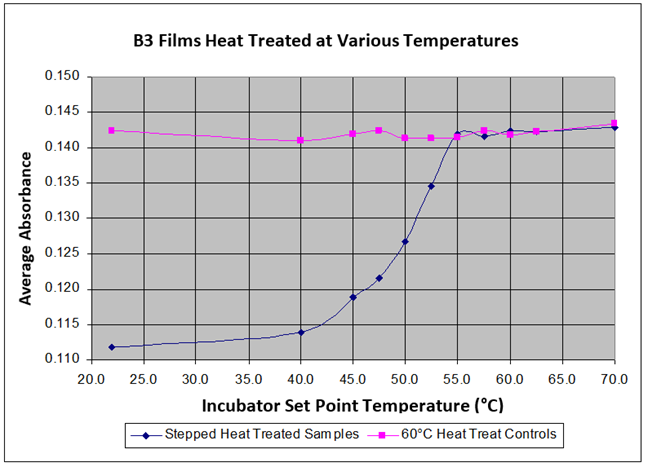
Post-irradiation heat treatment of B3 film is necessary to catalyze chemical reaction and finalize the color change. Heat-treatment is required for all users except those users exclusively using high doses (> 40 kGy) and high temperatures (> 55.0°C).
After heat-treatment, the radiation-induced color change of B3 dosimeters is stable for weeks when stored under normal laboratory conditions. The film stability allows users to measure the optical absorbance of B3 dosimeters in accordance with their business needs and allows for re-measurement days or weeks later.
Initial recommendations for heat-treatment were based on findings of the film’s inventor, Prof. Arne Miller of Risø High Dose Reference Laboratory (HDRL) in Roskilde, Denmark. Prof. Miller established the post-irradiation heat-treatment of bare B3 film strips and pieces in a box-style incubator for a five-minute time cycle at 60.0°C. His data indicated that this treatment provides a 100% color development, and B3 dosimeters heat-treated to these specifications would remain stable for more than one year; this specification has been used successfully at Risø since at least the late 1980’s.
While the length of time for treatment has been modified for other heat-treatment devices and for packaged dosimeters, the temperature parameters, established by Prof. Miller, produce the intended effect of film stabilization. Testing conducted by GEX and Risø HDRL has demonstrated that temperatures of between 55.0°C to 75.0°C effectively complete the color development and stabilize irradiated B3 films. The use of higher temperatures may be possible but are not recommended because this increases the risk of damaging the film.
The effect of heat-treatment on B3 film is easy to demonstrate with a simple test. The results of the test (depicted in Figure 1 below) were generated by irradiating ten (10) sets of B3 films to approximately 15 kGy, along with 10 sets of controls. The samples from each set were then heated at the increasing temperature settings and were plotted against the control set which was heated at 60.0°C simultaneously in a second incubator.
3 - General Information
3.1 Features of B3 film dosimeters before heat treatment
-
The natural post-irradiation color development of B3 dosimeters will continue for hours after irradiation.
-
The length of time for the dosimeter to complete this development is in the range of 0 to 24 hours or more dependent on the dose (kGy) and the temperature during irradiation.
-
The most significant changes in dosimeter absorbance after irradiation occur at lower doses (1 to 10 kGy). The signal 24 hours after irradiation may increase 30% compared to the signal measured immediately after irradiation.
-
Conversely, higher doses (> 40 kGy) may exhibit very little change in absorbance after irradiation; the color change is catalyzed by the heat generated by the irradiation process and any residual heat in the irradiation zone.
-
The color development can vary significantly between commercial e-beam and gamma processes due to the difference in the temperature profile of the two irradiation modalities, with the film often residing at elevated temperatures for hours of time in gamma versus the high dose rate and short exposure time of e-beam.
3.2 Features of post-irradiation heat treated B3 film dosimeters
-
The heating of B3 dosimeters to temperatures near the glass transition temperature (Tg) of PVB (approximately 58.0°C) creates a chain reaction which quickly completes the color development induced by irradiation.
-
The total time for treatment depends on the combination of the heating and dwell times:
-
The heating time is the time that it takes for the heat-treatment device to heat the film surface to the desired temperature (e.g. the set point temperature). This time will vary based on the design of the heat treatment device; this is typically 20 minutes or less.
-
The dwell time is the length of time the dosimeter resides in the heat-treatment device at the desired temperature or “set point”. One (1) minute of film surface temperature in excess of 58.0°C provides a complete catalyzation of the response function at lowest doses in the B3 dose range. However, lower temperatures may be used; they may require a longer dwell time.
-
-
Heat-treatment for excessive lengths of time will cause the absorbance to fade. The recommended maximum treatment time is 2 hours. Otherwise, an expansion of measurement uncertainty or maintenance of a different dosimeter calibration may be required because the variance between the recommended treatment time and the maximum treatment time may exceed a 1.0% change in absorbance.
4 - Operational Considerations
Users of B3 dosimeters need to consider the following concepts which may affect decisions about the validation and implementation of a heat-treatment process and the procedure used with dosimeters post-irradiation.
4.1 - General guidelines of acceptable temperature range for heat treatment:
4.1.1 - Heat Treated Outside the Package
-
It is suggested to use a temperature set point 60°C when dosimeters are placed into an incubator after removal from the packaging, such as lying flat on a piece of paper and placed into a forced air incubator
-
We recommend ±2.0°C for uniformity, although we also believe that more variation can be allowed and still generate a successfully heat-treated dosimeter
4.1.2 - Heat Treated Inside the Package
-
Use a set point of 58.5°C and keep the maximum temperature below 60°C. Use the narrowest uniformity of temperature possible closest to 58.5°C.
-
There is a risk of damage to the films when they are in the package due to softening of the film surface and the polymer liner or the pouch and the risk increases with every increasing degree that the user employs. See more information in the section “Risk of Film Damage” below.
-
Significant temperature differences (>5.0°C) can exist between the upper and lower shelves of a gravity-convection incubator. Use of forced-air incubators is a better option. Users will have to adjust the set point of forced air incubators accordingly to ensure the temperature range within the incubator meets their specification.
4.2 - General guidelines for acceptable time interval of incubation for heat treatment:
4.2.1 - Maximum dwell time of incubation
-
Data from studies in the early 2000’s led to a recommendation of 2 hours maximum. No additional substantiation of this maximum time interval has been performed by GEX or provided to GEX by users. Some users may wish to validate a maximum dwell time.
4.2.2 - Minimum dwell time of incubation
-
The user should validate the minimum dwell time they wish to establish.
-
The minimum time interval will depend on the temperature set point and the design of the incubator. Some incubators must recover after samples are inserted (e.g. P4850/P4855), while other types maintain their temperature when the user loads the dosimeters (e.g. P4900).
-
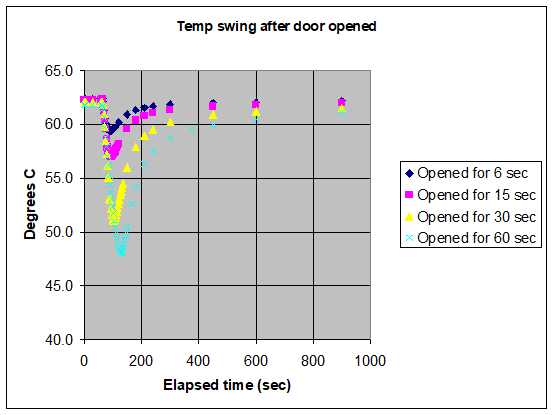
For general purposes, gravity-convection or forced-air incubators, the minimum incubation time depends on the recovery time for the model of incubator to heat back up to the set temperature when the door is left open for a period of loading the dosimeters. The incubator can often require 5-10 minutes or more for the temperature to recover to the set point due to the opening and closing of the door. Figure 2 below illustrates various recovery times when the door is opened and closed for different time intervals on a gravity-convection incubator. In general, 15 to 20-minute dwell times are common when using these types of incubators.
-
For the GEX P4900 Microincubator, the standard minimum length of heat treatment is 5 minutes when using 58.5°C as the set point. Some users have been satisfied with the B3 signal stability using an interval less than this. Other users have experienced unacceptable damage at 58.5°C and use a lower temperature which may require longer incubation dwell time.
4.3 - Risk of damage to films incubated in GEX Packaging
-
There is a significant risk of damage to B3 films if any material contacts the film, including another B3 dosimeter or the poly-liner of the pouch, when the film surface temperature exceeds the (Tg) of PVB 58.0°C. The risk of damage increases with every 1 °C above it that the user employs [3].
-
Removing the dosimeter from the pouch is the only way to eliminate the risk of damage; this is not practical for many users.
-
When two or more dosimeters are inside a pouch together, overlaying each other, excessive temperature can fuse the two films together also posing a threat to the ability to accurately measure them. Trying to separate the film can create a tear at which point the dosimeter is ruined and cannot be measured.
-
When GEX B3 dosimeters have significant, visible damage to the film surface in area where the optical measurement is performed, it may significantly affect the optical measurement result and dose measurement accuracy.
-
Minor damage to the film such as waviness, small lines or wrinkles have been shown to have little or no significant effect on measurement results in various customer studies.
-
The user cannot assess the impact of damage simply by observation. Instead, use calculations of C.V.% of measurement or other measure of variation to compare outcomes at different heat treatment settings.
-
If you experience major damage at the recommended settings, reduce the set point temperature by 1.0°C (set to 57.5°C) and retest. Continue to reduce in increments of 1.0°C or less until damage is minimized and stability of the B3 dosimeter response is still achieved. Use of temperatures below 55.0°C may or may not be effective.
4.4 - General guidelines for time interval between dosimeter irradiation and dosimeter heat treatment
-
The time interval should be estimated from the time the dosimeter leaves the irradiation zone and not just the time since it is retrieved from the process.
-
It is critical that the time interval used during the calibration of each B3 film dosimeter batch be as similar as possible to the process used for measuring routinely irradiated samples. The user should quantify any major differences.
-
It is not harmful to wait before heat-treatment. Less variation would be expected between dosimeters treated at 24- and 30-hour post-irradiation than there is between 15 minutes and 3 hours, despite the latter having a shorter time interval.
-
The time interval between irradiation and heat-treatment has been shown by some users to significantly contribute to the variance of the absorbance measurement. Some users have demonstrated a small effect and others a larger effect. The user should set the calibration and operational target time interval and then test above and below that time interval to determine the variability and adjust their measurement uncertainty accordingly.
Special note for Electron Beam process: For optimal results, heat-treat dosimeters at least 1 hour after irradiation for E-beam processes to allow the dosimeter to naturally respond to the massive amount of energy that was imparted by the beam. Some users may not be able to wait 1 hour and should test the effects of a shorter interval.
4.5 - General guidelines for time interval between dosimeter heat treatment and measurement (reading)
-
The time interval between heat-treatment and measurement has been demonstrated by GEX and our customers to have no significant effect on the resulting measurement, provided the dosimeters are kept in stable environmental conditions that are cool and dry.
-
While no specific tests have been performed to validate the effects of storage at different temperatures and humidity values after heat treatment, we can make a simple recommendation that dosimeters are stored between 10%RH and 80%RH and between 10°C and 30°C based on general experience and publications on radiochromic films and similar chemical dosimeters.
5 - References
-
Miller A., Batsberg W. and Karman W. A new radiochromic thin-film dosimeter system. Radiat. Phys. Chem. 31 (1988), 491-496
-
Technical Note E1, Risø High Dose Reference Laboratory (HDRL), “Stability of response of GEX DoseStix dosimeters heated after irradiation at different temperatures and different times”, 2010.
-
Magdalena Maria Skowyra, Christina Ankjærgaard, Liyun Yu, Lars René Lindvold, Anne Ladegaard Skov, Arne Miller, Glass transition temperature of Risø B3 radiochromic film dosimeter and its importance on the post-irradiation heating procedure, Radiation Physics and Chemistry, Volume 194, 2022, 109982, ISSN 0969-806X
Disclaimer - The information contained in this document is provided “as is” and is not a substitute for the user’s professional judgement. It is provided as a convenience to those using products provided by GEX Corporation who have sufficient technical skills to evaluate and properly apply the information in this document. It is the responsibility of the user of this document to ensure that the information in this document, and the use of such information, is accurate, complete, applicable to the product, suitable for the user’s purposes, and in compliance with all laws and regulations. GEX Corporation believes the information provided in this document is accurate and reliable as of the time of writing, but it undertakes no obligation to update or correct this document. GEX Corporation may, but is not required to, make changes to this document at any time without notice. By using the information in this document, the user represents and warrants that he or she has the skills necessary to properly understand and apply this information and that he or she will comply with all applicable laws and regulations including, without limitation, those relating to medical devices, pharmaceutical products, or other applicable industries. The user assumes all risks associated with using this information and any results or output resulting from the application of this information to GEX Corporation’s products. The user agrees not to hold GEX Corporation liable for any errors or omissions contained within.