
This document was originally published as GEX Doc. No. 100-217 Transfer Standard Alanine Study
Study publication date: September 2017
Background
Ionizing radiation is used to produce various desired effects in products. Examples of applications include; the sterilization of medical products, microbial reduction, modification of polymers and electronic devices, and curing of inks, coatings, and adhesives. Radiation dose measurements are necessary to ensure the effectiveness of the radiation process. Dosimetry systems used for these dose measurements must be calibrated traceable to a national standard with a stated level of dose measurement uncertainty.
Dose traceability requires evidence of an unbroken chain of calibrations from the realization of the Gray (Gy) as determined from a primary national standard of dose. Certified traceable doses can only be provided by approved high dose reference laboratories (HDRLs). Approved labs are either a primary national standard HDRL or a traceable ISO 17025 accredited secondary standard HDRL lab.
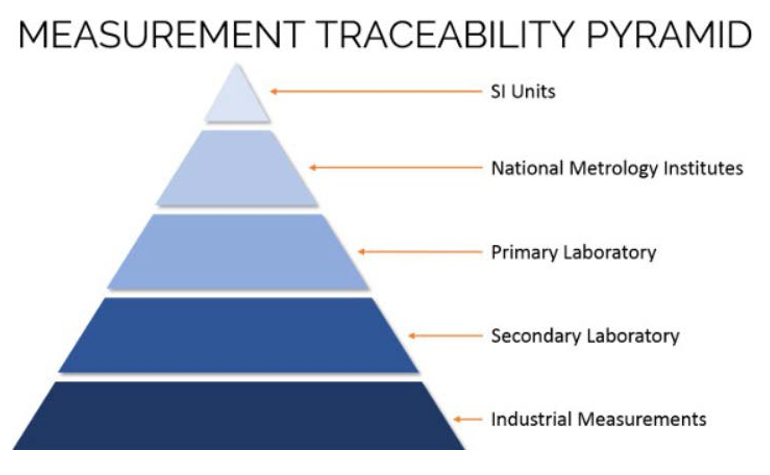
The ISO/ASTM 51261 Standard Practice for Calibration of Routine Dosimetry Systems for Radiation Processing specifies the requirements for calibrating routine dosimetry systems for use in radiation processing, including establishing measurement traceability. There are two methods for irradiating dosimeters that may be used for calibration of a dosimetry system.
-
Perform a full dosimetry system dosimeter batch specific calibration by irradiating representative dosimeter batch samples alongside reference transfer standard dosimeters, provided by an approved laboratory.
-
Irradiating representative dosimeter batch samples to known doses under fixed dose rate and temperature conditions, at an approved laboratory, followed by a calibration verification exercise with targeted dose irradiations performed in-situ or in the user’s plant; the user’s representative batch sample routine dosimeters are placed alongside reference transfer standard dosimeters, provided by an approved laboratory.
In either case, the use of reference transfer standard dosimeters is required.
Reference Transfer Standard Alanine Dosimetry
The successor to liquid chemical and radiochromic film reference transfer standard dosimetry is alanine dosimetry, which has demonstrated exceptional post-irradiation response stability that is key to postal-based transfer dosimetry services offered by calibration laboratories. The dosimetry system is based on irradiated crystalline alanine measured by electron paramagnetic resonance (EPR) spectrometry. Alanine is highly respected for its wide calibration dose range and environmental and time stable properties, and has become the transfer dosimetry system of choice for high-dose dosimetry services for National Metrology Institutes (NMI).
A large portion of the transfer standard alanine dosimeters being provided today have calibration traceability to either the NIST or NPL primary standards. NIST and NPL use somewhat different approaches in realizing the Gy to establish their primary standard of dose. These labs also use one or more types of internal transfer dosimetry systems, including alanine EPR dosimetry systems that use different sources of alanine pellets for their transfer standard alanine dosimetry. In addition, the two labs apply a different temperature factor (0.15%/°C vs 0.11%/°C) to adjust for transfer alanine irradiation temperatures that differ for their calibration temperature condition.
However, with all these differences, one should expect doses reported by these laboratories to be approximately “equivalent”, meaning their results should be expected to be normally distributed within the overall combined uncertainty limits of the laboratories. These laboratories and other NMIs along with other ISO 17025 accredited laboratories participate in periodic formal inter-lab comparisons conducted by the BIPM, and typically evidence agreement within 1.0% under controlled temperature and dose rate irradiation conditions at 1.0, 10.0, and 30.0 kGy doses.
Inter-comparison Study
GEX Corporation (Centennial, Colorado USA) conducted an independent blind study of transfer national standard traceable alanine dosimetry systems during August 2016. The primary purpose of the study was to evaluate the level of agreement (equivalency) of the NIST and NPL calibration dose chains. The study involved the co-location of NIST and NPL transfer alanine dosimeters, along with GEX (NIST traceable) and DTU Risø (NPL traceable) transfer alanine dosimeters that were irradiated to a range of targeted doses, in order to assess the equivalency of dose results of the two popular, primary standard traceability chains under “typical” industry usage conditions.
This four lab inter-comparison study included in-situ site irradiations carried out under both a “fixed” radiation Gammacell 220 field where dose rate and temperature were held constant, and the “variable” radiation field of a largescale industrial electron beam irradiator where dose rate and temperature were uncontrolled.
Transfer standard alanine dosimeters were obtained from the two primary standard NIST and NPL HDRLs, along with two ISO 17025 certified secondary HDRLs, GEX and DTU / Risø. The alanine pellet transfer dosimeter sets were prepared in individually labeled target dose point packages by GEX along with irreversible temperature indicators, and followed detailed irradiation, shipping, and handling instructions, then sent to the two irradiation sites.
The four sets of transfer alanine dosimeters for each dose point were irradiated by the individual sites to the targeted doses, and returned to GEX along with process records and irreversible temperature labels. GEX returned the transfer alanine packets to their respective labs with a specified average dose point temperature to be used to make appropriate temperature adjustments. The HDRLs were only instructed to prepare and report their doses in accordance with their established transfer alanine practices, and make appropriate temperature adjustments based on using the “average” irradiation temperatures as stipulated by GEX.
Study Results
Table 1 below provides the dose results as reported by the four laboratories.
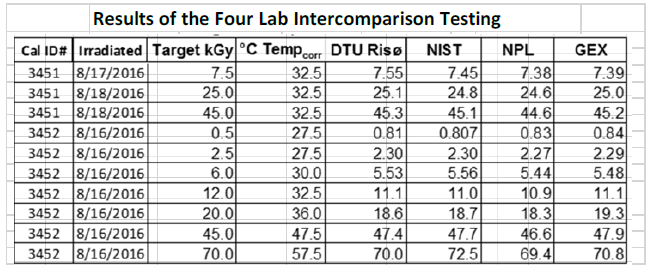
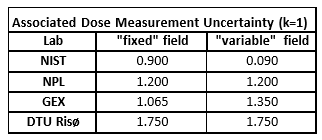
Table 2 below shows the associated uncertainties used in equivalency analysis calculations.
NOTE 1 - The temperature rise observed in the irreversible temperature indicators for the “variable” electron beam Cal 3452 dose points was not inconsistent with a normally expected 0.65 °C temperature rise in alanine and the 0.80 °C temperature rise in polystyrene per kGy of absorbed dose. The four HDRLs did apply different alanine response temperature adjustment factors ranging from a low of 0.11%/°C for NIST to a high of 0.15%/°C for NPL with GEX and DRU Risø each using a 0.14%/°C adjustment factor.
NOTE 2 - GEX assigned a higher average level of uncertainty associated with the doses for “variable” radiation conditions based on experience in providing in-situ irradiation transfer doses to industrial users. NIST, NPL and Risø reported the same levels of associated uncertainty for both “fixed” and “variable” irradiation doses with NPL, noting that ‘no consideration is given to response differences arising from differences in-user site irradiation conditions or the additional uncertainty differences in the event actual temperature may differ from the user stated temperatures’. NIST also noted that their stated uncertainty ‘does not attempt to account for uncertainties arising from customer reported temperatures or radiation field variability’, and provided a memo with usage instructions and conditional usage information along with their alanine shipment. DTU Risø provided both an average stated uncertainty value along with individual dose point uncertainty estimates as did GEX.
Analysis of Results
Analysis of results for the comparison and the degree of equivalence was determined by calculation of En-values as follows:
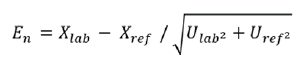
Where:
Xlab = the result of the specific HDRL transfer alanine dose Xref = the value of the reference (NIST, NPL GEX or Risø)
Ulab = the measurement uncertainty of the specific HDRL transfer alanine dosimetry system
Uref = the measurement uncertainty of the other lab or reference (NIST, NPL, GEX or DTU Risø transfer alanine dosimetry system)
The uncertainties were based on the NIST, NPL, DTU Risø, and GEX stated calibration uncertainty as calculated by GEX at k = 1, 2 and 3. En results of less than 1.0 are considered to evidence equivalency. Results are expected to be normally distributed and follow the so called “empirical rule” with 68% of the results falling within 1-sigma, 95% within 2-sigma, and 99.7% within 3-sigma. The distribution of En results may be plotted and evaluated for potential bias.
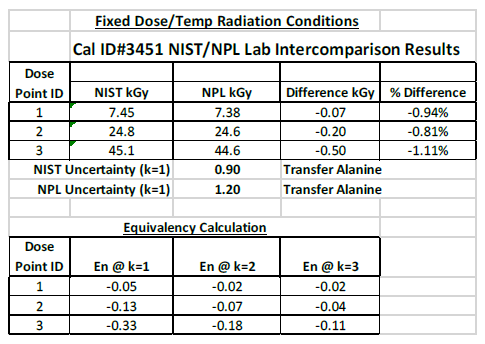
Results from the NIST and NPL primary standards labs for the “fixed” Gammacell 200 radiation field target irradiations are shown in Table 3 below. These results evidence close agreement with all dose points shown equivalent and in agreement within ±1-sigma of the overall combined uncertainty limits.
The NIST and NPL dose results from the “variable” industrial 10 MeV electron beam radiation process field are shown in Table 4 below.
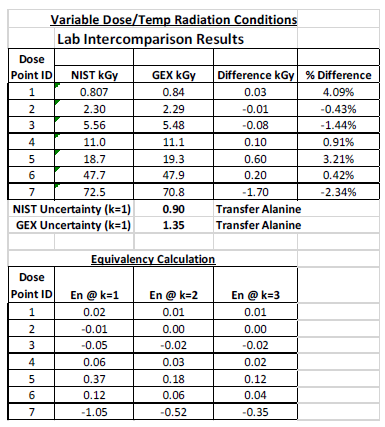
Dose results are shown to be equivalent and in agreement within the combined limits of the stated measurement uncertainty of the laboratories. Higher point-to-point variability is observable compared with the highly uniform results obtained from the “fixed” radiation field irradiations. However, these results also carry an expectation of higher variability associated with the “variable” irradiation conditions of a large-scale industrial field where temperature and dose rate variability come into play as well as higher dosimeter handling and placement uncertainty components.
For example, the variability of irradiation temperature measurements made in an industrial irradiator using irreversible temperature indicators with 2.5°C increments is larger than temperature measurements obtained using the high precision thermistor or thermocouple used to maintain and control fixed temperature Gammacell 220 irradiations.
In summary, the dose results obtained from the “fixed” and “variable” radiation field experiments indicate agreement with all but one dose point (70 kGy target) being in agreement within the ±1-sigma combined laboratory uncertainty limits.
The NIST-traceable calibration chain of dose used in the GEX dose estimates for the “fixed” irradiation conditions, as shown in Table 5 below, reflected close agreement, with all dose points found within ±1-sigma of the combined uncertainty limits of the labs.
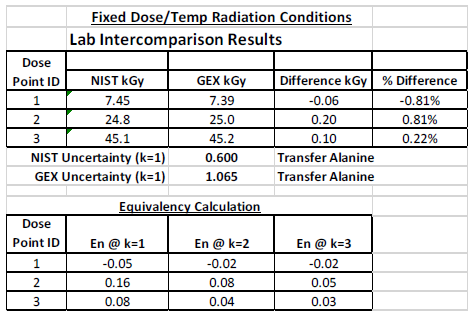
NIST / GEX comparison results obtained from the “variable” radiation field experiment were also shown to be in agreement, with all dose points shown equivalent within the ±2-sigma combined uncertainty limits of the labs.
The same equivalency analysis was also performed on the NPL calibration traceability chain by comparing the NPL results with the DTU Risø data as shown in Table 6 below.
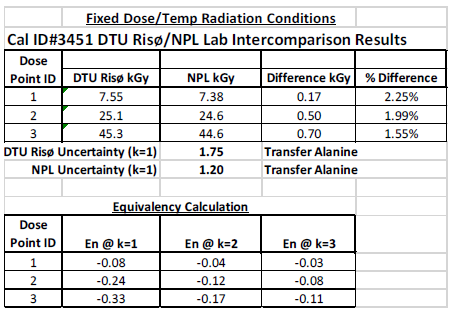
The DTU and NPL reported doses are shown to be equivalent with all dose points shown in agreement within ±1-sigma of the overall combined uncertainty limits stated by the labs.
Table 7 below are the DTU Risø/NPL comparison results for the “variable” irradiation conditions experiment.
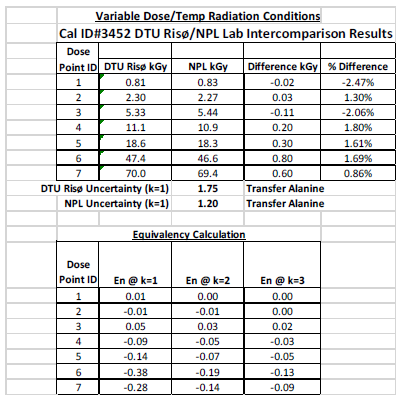
The DTU and NPL reported doses are shown to be equivalent with all dose points in agreement within ±1-sigma of the overall combined uncertainty limits stated by the labs.
The equivalency of the NIST and NPL primary standard traceability chains at the secondary standard lab level was also evaluated by comparing results between GEX that utilized a NIST-traceable calibration and DTU Risø which used an NPL-traceable calibration as shown in Table 8 below.
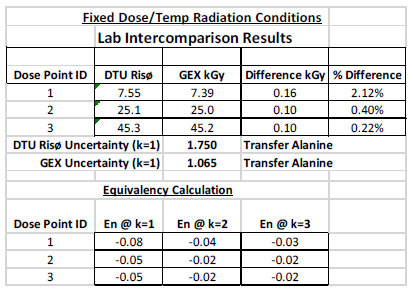
The results of the “fixed” radiation field conditions show the DTU Risø NPL-traceable doses and the GEX NIST-traceable equivalency demonstrated of all dose points within ±1-sigma limits.
Table 9 below are the comparison results for the “variable” radiation conditions of the 10 MeV industrial irradiator experiment.
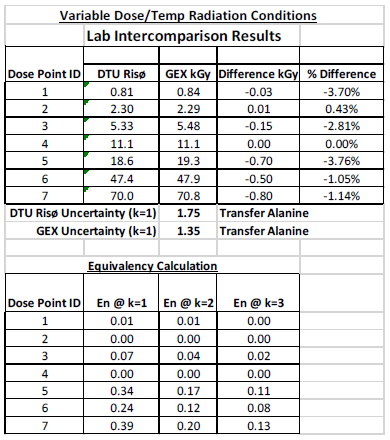
The results of the “variable” irradiation experiment show the DTU Risø and GEX reported doses to be equivalent within ±1 sigma of the overall combined limits of the labs.
Conclusion
Analysis of the data sets of doses reported by the four HDRL laboratory dose inter-comparison provides evidence that the traceable doses reported by the laboratories were shown to be equivalent within the normally expected overall combined uncertainty limits of the comparing laboratories.
This study, although limited to only a single set of “fixed” and “variable” radiation field experiments, does provide evidence that doses, as currently being realized and reported within the two major Primary National Standards laboratory dose chains, NIST and NPL, are demonstrated equivalent under actual “field” conditions when the stated combined uncertainties of the laboratories are taken into account.
The dose data from this study also provides an example of normally expected magnitude dose differences that may be expected to occur from a single calibration exercise. Multiple calibration exercises and calibration audit exercises would be expected to yield results consistent with this study and provide evidence of reproducibility.
Although formal HDRL inter-comparisons are performed and monitored by BIPM and reported in the literature periodically, field study experiments such as this demonstrate actual results obtained under normal industry usage conditions. GEX hopes to be able to continue to fund and conduct these types of actual industry usage studies to demonstrate the continued effectiveness among international dose standards. We are also hopeful that future funding of the national standard labs will be sufficient to sustain existing national dose standards, and support their continued staff participation in important international industry association activities.
References
Recent BIPM International High Dose Inter-comparisons:
-
1999 CCRI supplementary comparison of standards for absorbed dose to water in 60Co gamma radiation at radiation processing dose levels; D.T. Burns, P.J. Allisy-Roberts, M.F. Desrosiers, V. Yu. Nagy, P.H.G. Sharpe, R.F. Laitano, K. Mehta, M.K.H. Schneider, Y. Zhang; 1999.
-
2006 CCRI supplementary comparison of standards for absorbed dose to water in 60Co gamma radiation at radiation processing dose levels; D.T. Burns, P.J. Allisy-Roberts, M.F. Desrosiers, V.Yu. Nagy, P.H.G. Sharpe, R.F. Laitano, K. Mehta, M.K.H. Schneider, Y.L. Zhang; Radiation Physics and Chemistry 75 (2006) 1087–1092.
-
2011 Supplementary comparison CCRI(I)-S2 of standards for absorbed dose to water in 60Co gamma radiation at radiation processing dose levels; D T Burns, P J Allisy-Roberts, M F Desrosiers, P H G Sharpe, M Pimpinella, V Lourenço, Y L Zhang, A Miller, V Generalova, V Sochor.
Disclaimer -The information contained in this document is provided “as is” and is not a substitute for the user’s professional judgement. It is provided as a convenience to those using products provided by GEX Corporation who have sufficient technical skills to evaluate and properly apply the information in this document. It is the responsibility of the user of this document to ensure that the information in this document, and the use of such information, is accurate, complete, applicable to the product, suitable for the user’s purposes, and in compliance with all laws and regulations. GEX Corporation believes the information provided in this document is accurate and reliable as of the time of writing, but it undertakes no obligation to update or correct this document. GEX Corporation may, but is not required to, make changes to this document at any time without notice. By using the information in this document, the user represents and warrants that he or she has the skills necessary to properly understand and apply this information and that he or she will comply with all applicable laws and regulations including, without limitation, those relating to medical devices, pharmaceutical products, or other applicable industries. The user assumes all risks associated with using this information and any results or output resulting from the application of this information to GEX Corporation’s products. The user agrees not to hold GEX Corporation liable for any errors or omissions contained within.