
This document was formerly published as GEX Doc. No. 100-250 UV Control and Monitoring
1 - Purpose
To provide guidance for implementing protective measures to mitigate potential exposure to, or sufficiently protect B3 film dosimeters from UV-light sources and to provide test methods for initial qualification and requalification of mitigation measures.
2 - Scope
All B3 film users should evaluate the influence of UV-light, or lack thereof, or else they may have unknown bias(es) that can affect the accuracy of measurements.
3 - General Information
The optical absorbance measured at the peak wavelength (552nm) of B3 radiochromic film is sensitive to exposure from UV-light with wavelengths < 350 nm1 which can cause an increase in the absorbance. Users often need to measure the impact of UV-light in the areas of the facility where B3 is used to determine if the influence is significant (i.e., characterization of UV light influence). Results of significance can warrant mitigation actions before, during and/or after the irradiation and measurement of the dosimeters. When required, the user should qualify the actions taken and define frequency for requalification, often depending on the nature of the actions taken.
Exposure to intense UV from a source such as direct sunlight can be very significant in a very short amount of time (seconds). In general, with indoor overhead lights or windows the effect is far less pronounced but may still be significant over long time periods (minutes or hours).
With the increasing prevalence of and preference for using LED lighting in laboratories and manufacturing facilities, one major source of UV (overhead lighting) can often be completely avoided. However, failure to sufficiently protect B3 film from all significant sources of UV-light, including windows in the lab or during dosimeter usage in warehouses and irradiators could result in the introduction of bias in the measurement of the B3 film’s optical absorbance and subsequent calculation of dose (kGy).
As a general practice, B3 dosimeters should not be exposed to UV-light for longer time periods than are necessary for their setup, irradiation, retrieval, and measurement. Very often, the GEX B3 dosimeters are irradiated by customers in the GEX packaging which does have a UV barrier to protect the dosimeters. However, when dosimeters are outside of the factory packaging before, during, or after irradiation, or during measurement, they can be covered with paper or other UV protective layer to prevent unwanted exposure. Brief exposure of the film to UV-light, for example during the time it takes to remove a dosimeter from the package and insert into the dosimeter holder, will not cause any significant increase in the absorbance of B3 film except in intense UV-light environments such as direct sunlight.
Particularly in the dosimetry laboratory when measurements are ongoing daily it is recommended to mitigate all UV-light sources rather than expecting personnel to be responsible for protective actions every day.
4 - Procedure
Good Practices
-
Ensure dosimeter usage procedures include instruction to cover unpackaged B3 dosimeters in areas where mitigation will not be performed or has not been tested.
-
Use UV-free LED lighting in the dosimetry laboratory and elsewhere to the extent possible.
-
If B3 dosimeters are irradiated in their factory sealed packages, it is not necessary to verify the pre-irradiation storage and handling areas nor the radiation process areas outside the irradiation zone as the dosimeter packaging itself protects the B3 dosimeters from daylight and UV sources. The area of concern in this case would be any area the dosimeters are exposed to after removal from the factory package.
4.1 Prerequisite – The installation and operational qualification of the dosimetry system (IQOQ) should be complete before using the spectrophotometers to conduct this test.
4.2 First, identify areas where the dosimeters are handled outside of the factory packaging, during the irradiation process and in the dosimetry laboratory. In general, the dosimetry laboratory is the biggest area of concern.
4.3 If light entering the areas identified has any known UV component or if presence of UV is unknown, then it is suggested to test the area. Alternatively, some users may find it practical to implement protective measures to ensure there can be no UV-light that would significantly affect the B3 dosimetry.
4.4 Follow the instructions below to test for a UV-light effect on the B3 dosimeter absorbance. The average absorbance of a set of samples at each location will be measured at the beginning and end of an exposure to the area lighting for a predetermined time period will be compared to each other to evaluate for an increase in absorbance.
4.4.1 Determine the maximum amount of time that dosimeters could be exposed at the various locations or choose a standard time such as 24 hours. Consider additional time when dosimeters could be left exposed because they needed to re-measured or investigated after their initial measurement, for example.
Note: The longer the time interval the easier it is to detect small changes in the dosimeter absorbance, so it is suggested to use 72 hours at any location. If an effect is measurable after mitigation measures have been employed then the mitigation technique may need to change, or a shorter time interval tested.
4.4.2 For each location, assign three (3) to five (5) B3 film dosimeters to be used for measurement of the influence of UV-light.
4.4.3 Perform baseline readings of each set of samples. Remove the dosimeter from its packaging then measure the absorbance of each sample while protecting the dosimeters from as much exposure to the area lighting as possible.
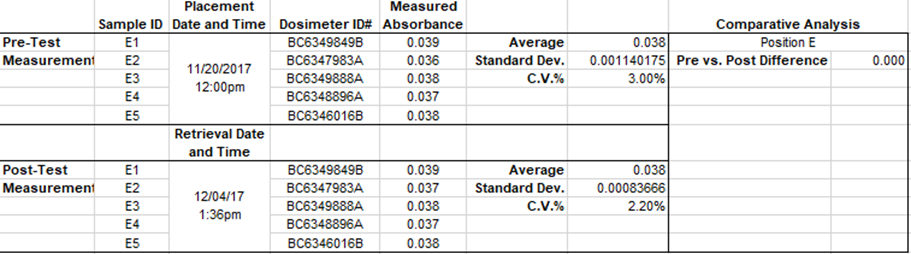
4.4.4 Calculate the average, standard deviation, and C.V.% for each set of dosimeters (i.e., each location).
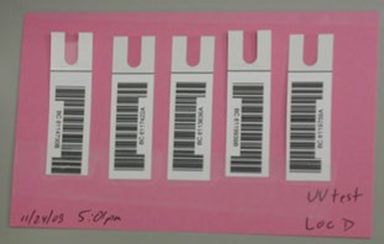
4.4.5 Affix each set of dosimeters for a single location to a 3” x 5” card or equivalent and write the location on each card.
4.4.6 Place the dosimeter sets at their specific locations and record the date and time of placement. See an example in the image below.
4.4.7 Retrieve each card after the samples have been exposed for the maximum time-period specified in the plan.
4.4.8 Measure the samples and again calculate the average, standard deviation, and C.V.% for each set.
4.4.9 The average absorbance of the samples in the set should not increase by more than 0.002 A and the data set should not exhibit a C.V.% of greater than 5% or using criteria determined by the user. Otherwise, there is a possible significant influence of UV-light in the area.
4.4.10 Below is an example of data analysis for a single location:
4.5 Obtain and apply UV barrier material to windows and light fixtures through which UV-light is emitted and/or implement any other mitigation methods.
4.6 Plan and execute qualification of the mitigation of UV-light in areas where action is taken using the same procedure and criteria set forth above.
4.6.1 An acceptable level of time exposure is user dependent and a maximum limit for dosimeter exposure to the area’s UV conditions can be established if any rate per unit time is detected.
4.7 Repeat the test once per year to requalify the mitigation methods and after any major changes to the lighting.
4.8 Any UV barrier materials used in light fixtures or on windows should be replaced at predetermined intervals as part of a preventative maintenance program. Consult the manufacturer of the material for more information on shelf-life of the material.
4.9 CAUTION: Visually verify that UV barrier material is not dislodged or moved from its original position following a change of light bulb or other maintenance activity that can affect the filter material location. It may help to secure any such barrier materials used.
5 - References
Miller, A., Batsberg, W., and Karman, W., “A New Radiochromic Thin-Film Dosimeter System,” Radiation Physics and Chemistry, Vol 31, 1988, pp. 491–496.
Disclaimer - The information contained in this document is provided “as is” and is not a substitute for the user’s professional judgement. It is provided as a convenience to those using products provided by GEX Corporation who have sufficient technical skills to evaluate and properly apply the information in this document. It is the responsibility of the user of this document to ensure that the information in this document, and the use of such information, is accurate, complete, applicable to the product, suitable for the user’s purposes, and in compliance with all laws and regulations. GEX Corporation believes the information provided in this document is accurate and reliable as of the time of writing, but it undertakes no obligation to update or correct this document. GEX Corporation may, but is not required to, make changes to this document at any time without notice. By using the information in this document, the user represents and warrants that he or she has the skills necessary to properly understand and apply this information and that he or she will comply with all applicable laws and regulations including, without limitation, those relating to medical devices, pharmaceutical products, or other applicable industries. The user assumes all risks associated with using this information and any results or output resulting from the application of this information to GEX Corporation’s products. The user agrees not to hold GEX Corporation liable for any errors or omissions contained within.